MetaTrader 4 (MT4) is a popular electronic trading platform used by retail forex traders to access global markets. It's provided by brokers to their clients, allowing trading in forex, indices, commodities, and CFDs. MT4 does not hold trader funds; it's purely a trading interface.
| Feature |
 Gerchik & Co Gerchik & Co
|
 FP Markets FP Markets
|
 JustMarkets JustMarkets
|
 CMC Markets CMC Markets
|
|---|---|---|---|---|
| Regulators | VFSC · FSC Mauritius | ASIC · CySEC · FSCA · CMA · FSA Seychelles | CySEC · FSCA · FSA · FSC · FSC | FCA · ASIC · MAS |
| Founded | 2015 | 2005 | 2012 | 1989 |
| Execution | STP | ECN, DMA | STP | Market Maker |
| Min Deposit | $10 | $100 | $10 | $0 |
| EUR/USD Spread | 1.0 pips | 0.19 pips | 1.0 pips | 0.5 pips |
| GBP/USD Spread | 0.4 pips | 1.51 pips | 129.81 ms | 0.9 pips |
| Gold Fee | $10 | $0.13 to $0.16 pips | 2.0 pips | $0.35 |
| Platforms | MT4, MT5, CopyTrading | MT4, MT5, cTrader, Iress | MT4, MT5, Mobile App, CopyTrading | MT4, MT5, Web, Mobile, TradingView |
| Open Account Read review | Open Account Read review | Open Account Read review | Open Account Read review |
This page focuses on MetaTrader 4 (MT4), a widely used trading platform, and what you should know when looking for a broker that offers it. We’ll cover what MT4 is, its key features, how it compares to other platforms, and what to consider when selecting an MT4 broker.
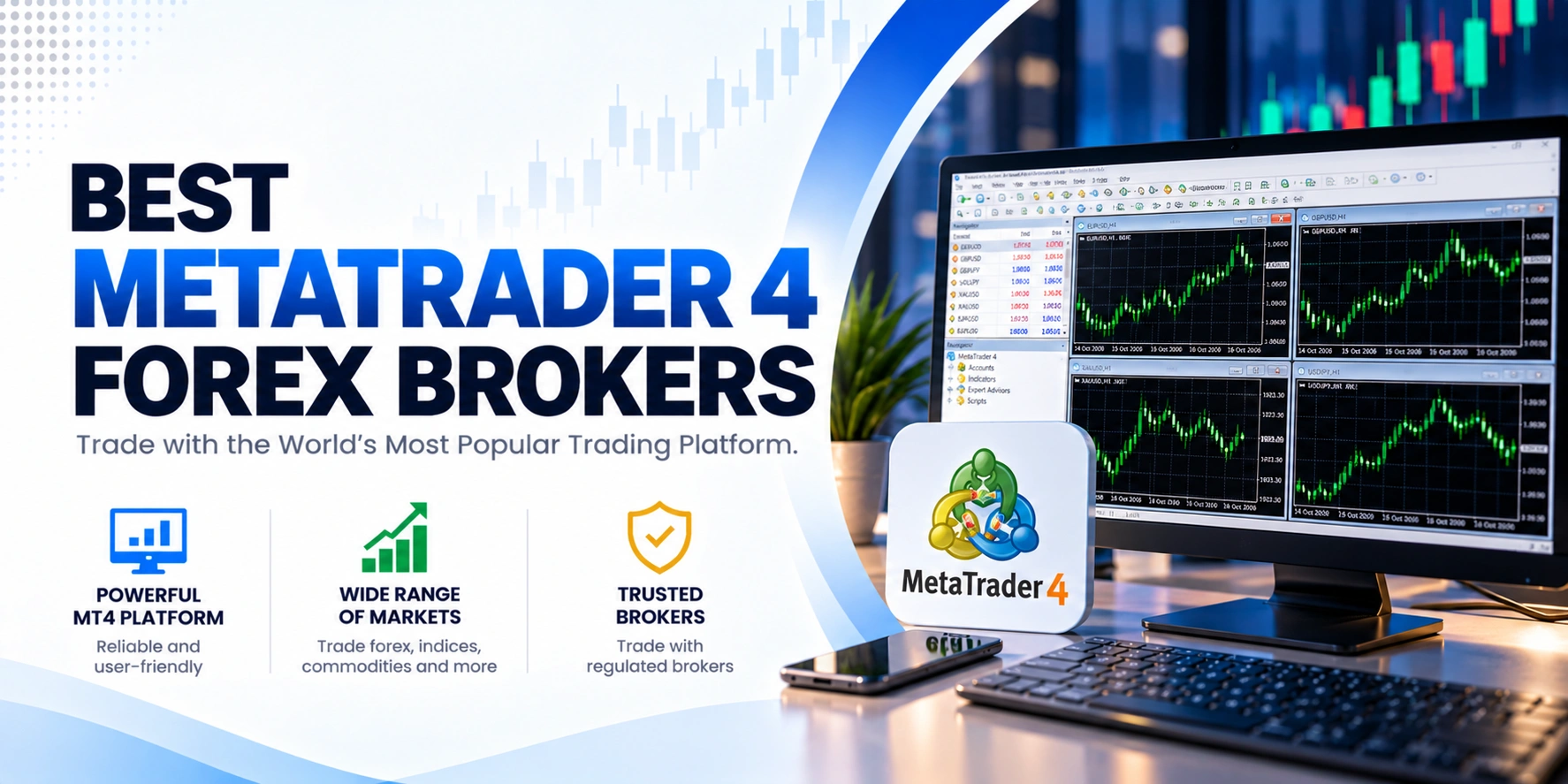
Before opening an account, always check a broker’s regulatory status, available asset classes, and trading costs. Understanding these factors helps ensure you pick a broker that aligns with your trading goals and provides a secure environment.

Tickmill operates under a robust multi-regulatory framework, holding licenses from several reputable financial authorities. This extensive oversight, including Tier-1 regulators like the FCA and CySEC, provides a high level of client protection. The broker also segregates client funds and offers negative balance protection, reinforcing its…

Admirals operates under the supervision of several reputable financial authorities globally, offering a robust regulatory framework. This includes Tier-1 regulators like CySEC and FCA, alongside Tier-2 and Tier-3 licenses. Client funds are segregated, and negative balance protection is in place, enhancing overall safety for traders,…
AvaTrade operates under a robust multi-jurisdictional regulatory framework, holding licenses from numerous financial authorities globally. While it boasts a strong presence in Tier 1 and Tier 2 jurisdictions, it also holds licenses from Tier 3 regulators. Client funds are segregated, and negative balance protection is…
BlackBull Markets operates under regulation from the Financial Markets Authority (FMA) in New Zealand and the Financial Services Authority (FSA) in Seychelles. The FMA provides robust oversight, offering a higher level of client protection, including segregated funds and negative balance protection for some retail clients.…
TradeQuo operates as a highly strategic, multi-jurisdictional brokerage group that successfully blends premium regional oversight with flexible offshore licensing to offer an optimal, multi-tiered trading environment. The group establishes deep institutional credibility through its regional entities, notably Tradequomarkets Financial Services L.L.C which is authorized and…
FBS operates under a multi-regulatory structure, holding licenses from the FSC in Belize, CySEC in Cyprus, and ASIC in Australia. This setup offers clients varying levels of protection depending on their registered entity. While CySEC and ASIC provide robust oversight, the FSC license is considered…
IUX operates under multiple regulatory bodies to ensure a secure trading environment for its global client base. The group holds licenses from reputable authorities including ASIC in Australia and the FSCA in South Africa. Retail clients are primarily onboarded under their FSC Mauritius entity, which…
Vantage Markets operates under a complex regulatory structure, holding licenses from several authorities globally. Client funds are segregated, and negative balance protection is offered to eligible clients, though not universally guaranteed across all entities.

Trade Nation operates under the oversight of several reputable financial authorities, including the UK’s FCA and Australia’s ASIC, which are considered top-tier regulators. This multi-jurisdictional licensing provides a robust framework for client protection, including segregated funds and negative balance protection for retail clients. While some…
Pepperstone operates under the oversight of several reputable financial authorities globally, including ASIC, FCA, and CySEC. This multi-jurisdictional regulation provides a strong framework for client protection, with segregated funds and negative balance protection for retail clients. While generally considered safe, traders should be aware of…
WELTRADE operates under several legal entities with varying regulatory oversight. While Weltrade SA (Pty) Ltd is regulated by South Africa’s FSCA, other entities are registered in jurisdictions like Saint Vincent and the Grenadines and Saint Lucia. These registrations offer limited financial supervision for forex trading…
Key To Markets operates under the regulation of the Financial Services Commission (FSC) of Mauritius, which is a Tier-3 regulator. The broker segregates client funds, a standard safety measure. While it previously held an FCA license, this has since been revoked. Traders should note that…
XTrend Speed is regulated by the Financial Sector Conduct Authority (FSCA) in South Africa, operating under Rynat Capital (Pty) Limited. While FSCA is a recognized financial authority, secondary sources like WikiFX and FastBull report significant regulatory warnings and unverified licenses, including revoked CySEC regulation. This…
MetaTrader 4 (MT4) is an electronic trading platform developed by MetaQuotes Software Corp. It’s widely used by online retail foreign exchange speculative traders to access global financial markets. Brokers provide MT4 to their clients as a gateway to pricing, charts, and trading functions. It’s important to remember that MT4 is a trading platform, not a broker itself, and it does not hold trader funds. While primarily designed for forex, brokers can offer trading in other asset classes like indices, commodities, CFDs, and even stocks and cryptocurrencies through the platform.
MT4 offers various chart types, including candlestick, bar, and line, along with a suite of drawing tools for identifying trendlines and channels. It includes 9 standard timeframes: M1, M5, M15, M30, H1, H4, D1, W1, and MN, ranging from 1 minute to 1 month. Traders can also set custom timeframes using specific scripts like “period converter” to suit their analytical needs.
The platform comes with over 30 built-in technical indicators such as MACD, RSI, Moving Averages, and Bollinger Bands. Traders can also access a vast library of over 2,000 free and 700 paid custom indicators, or create their own using the MQL4 programming language. Automated trading is fully supported through Expert Advisors (EAs), which are trading bots written in MQL4 that execute trades based on predefined rules. EAs only trade while the terminal is open and automated trading is allowed.
MT4 supports copy trading, also known as social trading, through the MetaTrader Signals service. This allows users to automatically replicate the deals performed by other traders in real time. The platform is available for mobile devices (iOS and Android), offering essential functions like placing orders, viewing charts, and setting price alerts. A web version also allows trading directly from any browser and operating system (Windows, Mac, Linux) with no additional software, providing real-time quotes, 30 indicators, graphical objects, and 9 timeframes.
While both are MetaQuotes platforms, MetaTrader 4 (released in 2005) and MetaTrader 5 (released in 2010) have key differences. MT4 uses the MQL4 programming language, while MT5 uses MQL5, meaning Expert Advisors written for MT4 do not run on MT5 without being rewritten. MT4 primarily focuses on Forex and CFDs, whereas MT5 is a multi-asset platform designed to support stocks, futures, options, and bonds in addition to Forex and CFDs.
MT5 offers more timeframes (21 vs. MT4’s 9) and a greater number of built-in indicators (38 vs. MT4’s 30). MT5 also expands on pending order types, adding two Stop Limit orders to MT4’s four. For position accounting, MT4 uses a multiple-position (hedging) model, while MT5 supports both netting and hedging. Furthermore, MT5’s Strategy Tester is multi-threaded, multi-currency, and can test using real ticks for more efficient backtesting, and it includes a built-in economic calendar that MT4 lacks.
MT4 is widely adopted across the forex industry, making it easy to find brokers that support it. Its robust charting tools, extensive library of over 30 built-in indicators, and support for Expert Advisors (EAs) offer powerful analytical and automated trading capabilities. The large MQL4 community provides a vast resource for custom tools, indicators, and trading signals, allowing traders to personalize their experience and automate strategies.
While powerful, MT4 is primarily designed for forex and CFDs. If you’re looking to trade a broader range of asset classes like stocks, futures, options, or bonds directly from a single platform, MT4 might not be the most comprehensive choice compared to its successor, MT5. Its programming language, MQL4, is older than MT5’s MQL5, and its strategy tester is single-threaded, which can be slower for backtesting complex EAs and optimizing parameters.
Risk warning: Trading forex and CFDs carries a high level of risk and may not be suitable for every investor. You can lose some or all of your capital. This page is general information, not investment advice. Check a broker’s licence on the official register and read its terms before you open an account.
MetaTrader 4 (MT4) is an electronic trading platform widely used by retail forex traders to access global markets. Developed by MetaQuotes Software Corp., it’s provided by brokers to their clients for trading various financial instruments.
MT4 is primarily designed for foreign exchange (Forex) trading. Depending on the broker, it also allows trading in indices, commodities, and CFDs. Some brokers may even offer stocks and cryptocurrencies through the platform.
Yes, MT4 fully supports automated trading through Expert Advisors (EAs). These are trading bots written in the MQL4 language that execute trades based on predefined rules. EAs require the MT4 terminal to be open and automated trading enabled.
MT4, released in 2005, primarily focuses on forex and uses MQL4. MT5, released in 2010, is a multi-asset platform supporting more instruments and uses MQL5. MT5 also offers more timeframes, indicators, and an enhanced strategy tester.
When choosing an MT4 broker, consider their regulatory status, available asset classes, and trading costs like spreads and commissions. Also, check their execution speed, customer support, and minimum deposit requirements to ensure they fit your needs.
Yes, MetaTrader 4 is available for mobile devices on both iOS and Android. The mobile app provides essential functions like placing orders, viewing charts, and setting price alerts, allowing you to manage your trades on the go.
MT4 supports various order types, including market orders for immediate execution. It also offers pending orders like Buy Limit, Sell Limit, Buy Stop, and Sell Stop, along with Stop Loss and Take Profit orders for risk management.
To start, download the MetaTrader 4 platform and begin with a demo account to practice without real capital. Once ready, log in to your live broker account using your account number, password, and the correct server to begin trading.