What You’ll Learn
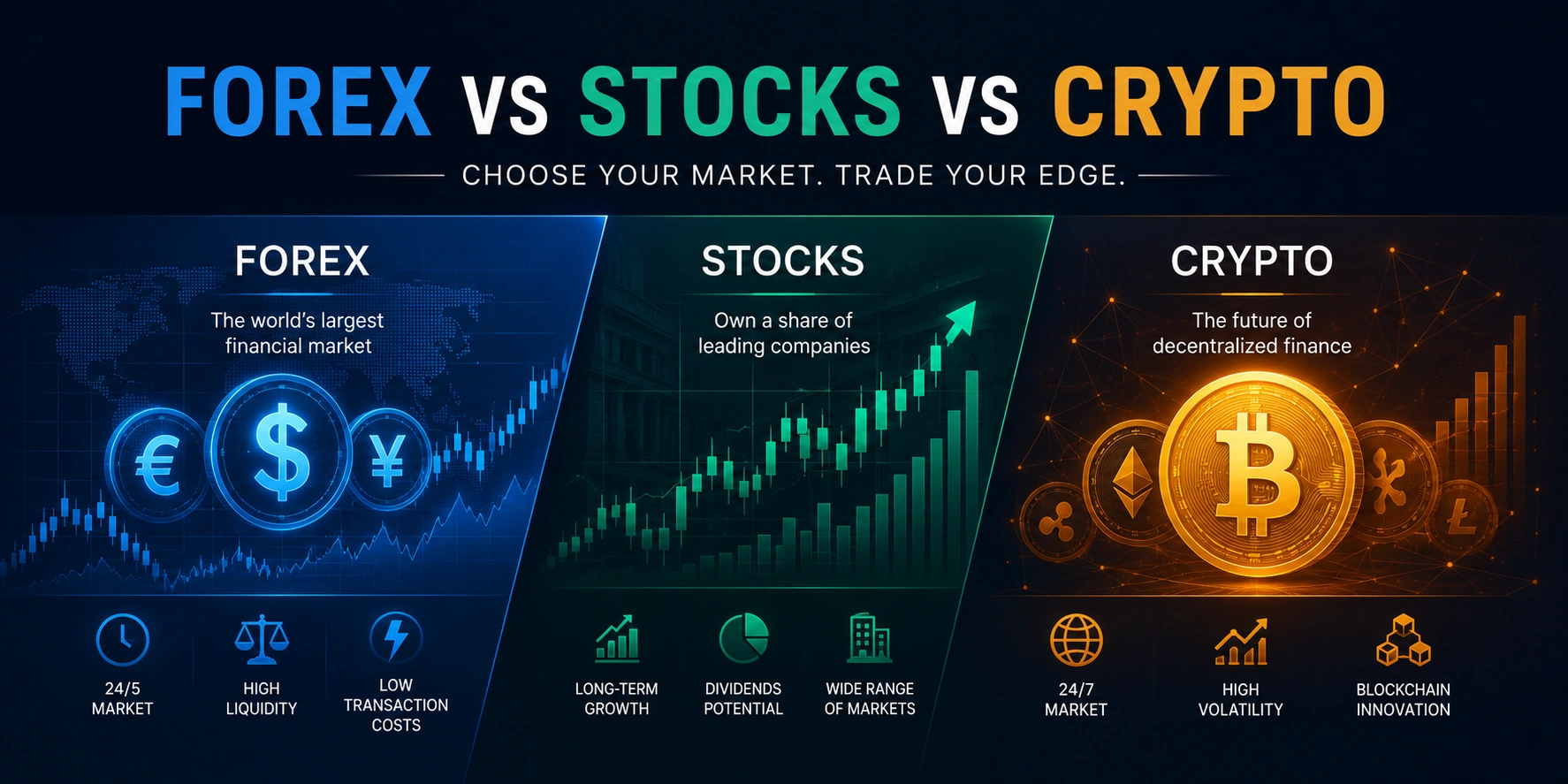
If you’re trying to decide where to start trading, you’ve almost certainly asked yourself: what’s the difference between forex, stocks, and crypto? The short answer is that all three let you speculate on price movements, but they operate in completely different markets, with different hours, risks, costs, and mechanics. Knowing those differences before you deposit a single dollar is one of the most important steps you can take as a beginner.
Before you can compare the three markets, you need a clear picture of what you’re actually buying and selling in each one.
The foreign exchange market (forex) is where currencies are bought and sold against each other. You never buy a single currency on its own — you always trade a currency pair like EUR/USD (euro versus US dollar) or GBP/JPY (British pound versus Japanese yen). If you buy EUR/USD, you’re betting the euro will rise in value against the dollar. Forex is the largest financial market on Earth, with over $7.5 trillion changing hands every single day.
Stocks (also called shares or equities) represent fractional ownership in a company. When you buy one share of Apple (AAPL), you own a tiny slice of that business. Your profit or loss depends on the company’s performance, broader economic conditions, and investor sentiment. Stocks trade on regulated exchanges like the New York Stock Exchange (NYSE) or NASDAQ.
Cryptocurrency refers to decentralised digital assets secured by blockchain technology. Bitcoin (BTC), Ethereum (ETH), and thousands of altcoins trade on crypto exchanges like Binance or Coinbase. Unlike stocks, crypto doesn’t represent ownership in a business. Unlike forex, it isn’t backed by a government or central bank. It’s essentially a market driven by technology adoption, speculation, and sentiment.
| Feature | Forex | Stocks | Crypto |
|---|---|---|---|
| Trading Hours | 24 hours, 5 days a week | Exchange hours only (e.g. 9:30am–4pm EST) | 24 hours, 7 days a week |
| Daily Volume | ~$7.5 trillion | ~$200–300 billion (US markets) | ~$50–100 billion |
| Typical Leverage | Up to 50:1 (retail, US); 500:1 offshore | Up to 2:1 (US retail) | Up to 100:1 on some exchanges |
| Volatility | Moderate (major pairs) | Low to moderate | Very high |
| Regulation | Strong (FCA, CFTC, ASIC) | Very strong (SEC, FCA) | Light to moderate (varies by country) |
| Entry Cost | Can start with $100–$500 | Can start with $1 (fractional shares) | Can start with $10 |
Let’s say EUR/USD is trading at 1.1000. You believe the euro will strengthen against the dollar, so you buy 10,000 units (one mini lot) at that price.
Now flip it: if EUR/USD had dropped to 1.0950, you’d be down $50. This is why leverage amplifies both gains and losses. You didn’t lose $50 out of $10,000 — you lost $50 out of the $200 you actually put up.
You buy 10 shares of Microsoft (MSFT) at $400 each, costing you $4,000 in total capital. No leverage is used.
Notice the key difference: the stock trade required $4,000 of real capital for a $200 gain, while the forex trade required just $200 of margin for a similar $50 gain. Forex leverages your capital further, but it also concentrates your risk significantly.
Forex is considered moderate risk for major pairs like EUR/USD or USD/JPY. These currencies move in relatively tight ranges day to day — often 50–150 pips. The danger isn’t the market itself; it’s the leverage most beginners use without a proper risk management plan. Don’t let high leverage tempt you into oversizing positions.
Stocks carry company-specific risk — one bad earnings report, a regulatory fine, or a CEO scandal can drop a share price 20% overnight. However, you can reduce this by diversifying across multiple stocks or investing in index funds. The regulatory framework is robust, and publicly listed companies must disclose financial information regularly. It’s the most transparent of the three markets.
Crypto is the most volatile of the three. Bitcoin has dropped 80% from peak to trough multiple times in its history. A coin can lose 50% of its value in a single week — or gain the same. Regulation is still catching up globally, which means you have fewer protections if an exchange collapses or a project turns out to be fraudulent. If you’re drawn to crypto, you’ll want to treat it as the highest-risk portion of any portfolio.
There’s no single correct answer, but here’s a practical framework you can use right now:
Open a free demo account on a regulated forex broker (such as one regulated by the FCA, CFTC, or ASIC) and simultaneously track 2–3 stocks and one major cryptocurrency like Bitcoin for two weeks. Don’t trade real money yet — just watch how each market moves during the same news events. You’ll immediately see the difference in volatility, reaction speed, and trading hours. This comparison exercise alone will tell you more about your own temperament as a trader than any article can.
Forex, stocks, and crypto are three distinct markets with different mechanics, risk levels, and participant profiles. Forex offers high liquidity, leverage, and round-the-clock weekday access, making it popular with active traders. Stocks provide regulated ownership in real businesses, with lower volatility and strong investor protections. Crypto delivers maximum volatility and 24/7 access, but with fewer safeguards and unpredictable price swings. As a beginner, your job isn’t to pick the “best” market — it’s to pick the one that matches your available time, capital, risk tolerance, and learning style. Start with a demo account, observe how each market behaves, and let your experience guide your decision.