What You’ll Learn

The forex market, short for the foreign exchange market, is where currencies are traded. It’s the largest and most liquid financial market in the world, with trillions of dollars exchanging hands daily. For you, as an aspiring trader, understanding how this market works is the absolute first step towards potentially participating in it.
In this lesson, you’ll get a clear, structured overview of the forex market’s fundamental mechanics. We’ll break down how currencies are traded, introduce you to essential terminology, and walk you through practical examples so you can grasp the core concepts.
At its core, the forex market is a global marketplace for exchanging national currencies. Imagine you’re traveling from the US to Europe; you’ll need to exchange your US Dollars (USD) for Euros (EUR). That’s a simple foreign exchange transaction. The forex market is where these exchanges happen on a massive scale, constantly, all around the clock.
What makes the forex market unique is its decentralized nature. Unlike a stock exchange with a physical location, forex trading doesn’t happen on a single exchange. Instead, it occurs “over-the-counter” (OTC) directly between participants via a global network of banks, brokers, institutions, and individuals. This network stretches across major financial centers like London, New York, Tokyo, Sydney, and others, ensuring trading can continue 24 hours a day, five days a week.
The sheer size of this market is staggering. Daily trading volumes often exceed $6 trillion, making it far larger than the global stock or bond markets combined. This enormous liquidity means you can usually enter and exit trades quickly, with minimal price impact.
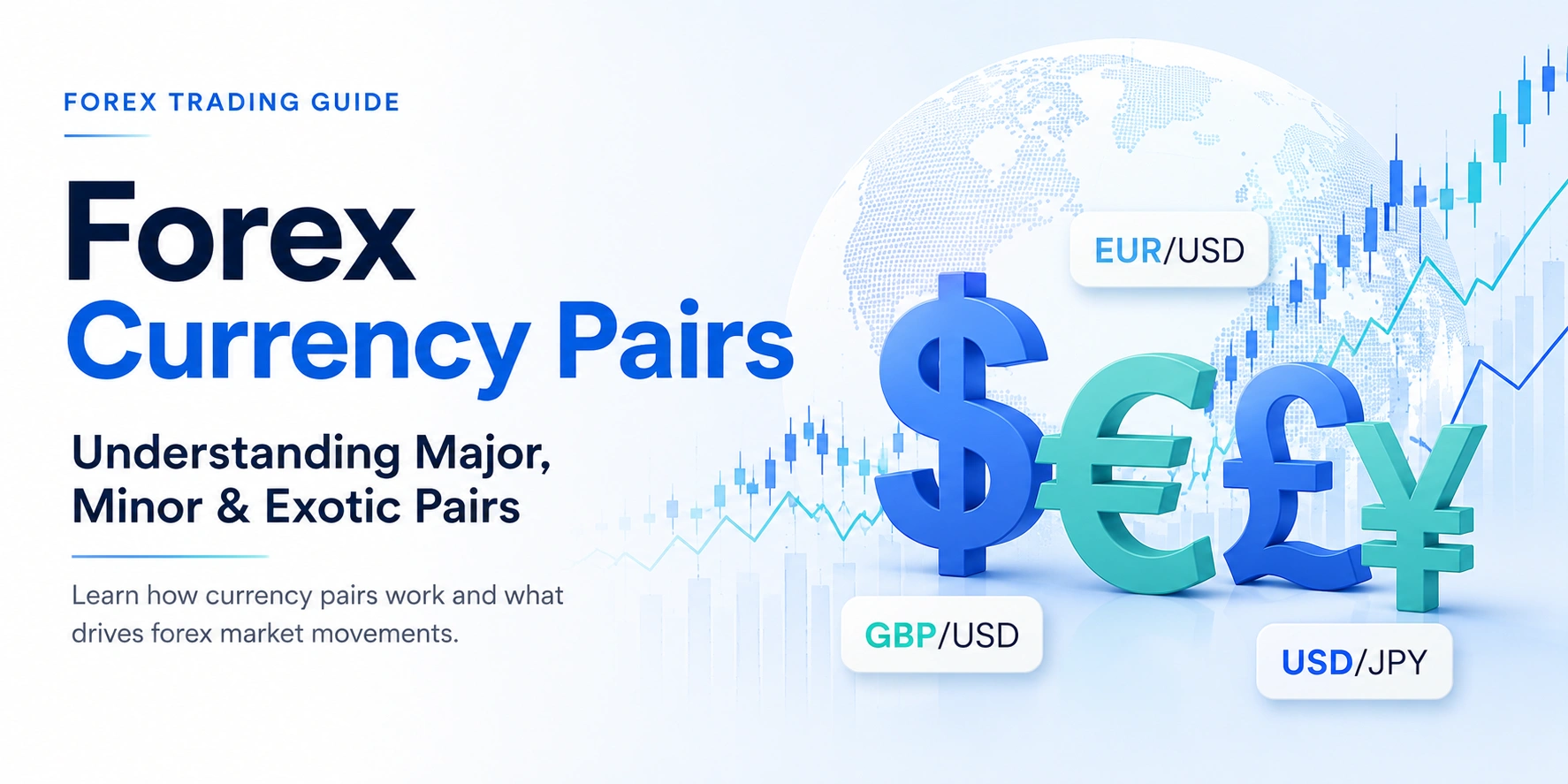
When you trade forex, you’re not buying or selling a physical currency. Instead, you’re speculating on the relative value of one currency against another. Currencies are always traded in currency pairs.
A currency pair consists of two currencies:
For example, in the EUR/USD pair, EUR is the base currency, and USD is the quote currency. The price of EUR/USD tells you how many US Dollars it takes to buy one Euro. If EUR/USD is trading at 1.1000, it means 1 Euro equals 1.1000 US Dollars.
When you buy a currency pair, you’re buying the base currency and simultaneously selling the quote currency. You’re expecting the base currency to strengthen relative to the quote currency.
When you sell a currency pair, you’re selling the base currency and simultaneously buying the quote currency. You’re expecting the base currency to weaken relative to the quote currency.
When you look at a currency quote from your broker, you’ll typically see two prices:
The difference between the bid and ask price is called the spread. This is effectively your broker’s commission for facilitating the trade. A tighter (smaller) spread is generally better for you.
Before diving into examples, let’s clarify a few critical terms you’ll encounter constantly.
A pip (percentage in point) is the smallest unit of price movement in a currency pair. For most currency pairs, a pip is the fourth decimal place (0.0001). For JPY pairs (e.g., USD/JPY), a pip is typically the second decimal place (0.01).
Understanding pip value is crucial because it determines the monetary value of your profit or loss. For example, if EUR/USD moves from 1.1000 to 1.1001, that’s a 1-pip increase.
Currencies are traded in specific quantities called lots. Here are the standard lot sizes:
The larger the lot size, the higher the pip value, meaning a larger potential profit or loss for each pip movement.
Leverage allows you to control a larger amount of currency with a relatively small amount of your own capital. It’s expressed as a ratio, like 1:50, 1:100, or 1:500.
If your broker offers 1:100 leverage, it means for every $1 of your own capital, you can control $100 in the market. This can significantly amplify your potential profits, but it also magnifies your potential losses. It’s a double-edged sword that requires careful risk management.
The portion of your capital that’s set aside to open and maintain a leveraged position is called margin. It’s not a fee but a deposit to cover potential losses. If you use 1:100 leverage, to open a standard lot (100,000 units) of EUR/USD at 1.1000, you’d need $1,100 (100,000 * 1.1000 / 100) in margin.
Let’s put these concepts into practice with some real-world examples.
You believe the Euro will strengthen against the US Dollar. So, you decide to buy EUR/USD.
Calculation of Pip Value:
For a standard lot of EUR/USD, the pip value is typically $10 per pip (100,000 units * 0.0001 = 10 USD).
Required Margin:
(100,000 EUR * 1.1000 USD/EUR) / 100 leverage = $1,100
Scenario 1: Price Rises (Profit)
The price moves in your favor, and you decide to close your trade when EUR/USD reaches 1.1050.
Scenario 2: Price Falls (Loss)
The price moves against you, and you decide to close your trade when EUR/USD falls to 1.0970.
You believe the US Dollar will weaken against the Japanese Yen. So, you decide to sell USD/JPY.
Calculation of Pip Value:
For JPY pairs, a pip is the second decimal place (0.01). For a mini lot of USD/JPY, the pip value is (10,000 units * 0.01) / 145.00 (current exchange rate) ≈ $0.689 per pip. (Many brokers simplify this to a fixed amount, but this is the precise calculation).
Required Margin:
(10,000 USD / 50 leverage) = $200
Scenario 1: Price Falls (Profit)
The price moves in your favor (USD weakens), and you close your trade when USD/JPY reaches 144.50.
Scenario 2: Price Rises (Loss)
The price moves against you (USD strengthens), and you close your trade when USD/JPY rises to 145.80.
ForexDailyInfo Pro Tip: Before you consider trading with real money, you absolutely must spend time practicing on a demo account. Demo accounts allow you to trade with virtual funds in a live market environment, letting you apply what you’ve learned without any financial risk. It’s the best way to get comfortable with your trading platform, understand how market orders work, and test your strategies. Don’t skip this crucial step!
You’ve now got a foundational understanding of how the forex market works. You know it’s a massive, decentralized global marketplace where currencies are traded in pairs. You’ve grasped key concepts like pips, lot sizes, and the powerful, yet risky, tool of leverage. The worked examples demonstrated how profits and losses are calculated when you buy (go long) or sell (go short) a currency pair. Remember, success in forex trading begins with a solid education and prudent risk management, starting with extensive practice on a demo account.